Why Is There Anything at All?
As a being conscious of its own existence possessing the faculty of reasoning, it is the very nature of that being blessed with powers of observation to ask a question at the root of all questions. A question inseparable from reality itself, known simply as the fundamental question of metaphysics. Why is there something rather than nothing?

Conscious reactions
There are two emotions you may feel when considering that question. If you’re unlucky you feel a deep existential terror at the thought that what you are consciously experiencing right now shouldn’t exist, how can something come from nothing? You may start to disbelieve reality thinking it’s somehow less real than it appears. However, there is no denying that you are currently experiencing something which means that somehow beyond a doubt, a miracle has happened.
If you’re lucky you’ll feel a different emotion, one of existential wonder and amazement. Reality may appear unstable as in the previous case but the instability isn’t terrifying. In fact it is quite exhilirating to know that experience is occurring at all. You feel a sense of relief and appreciation at the fact that you are experiencing a miracle, a thought that brings immense joy and a fresh new perspective on life.
Has humanity ever come close to a resolution? As you might imagine we’re probably more likely to become a multi-stellar species before we come close to addressing this problem in the domain of physics. On the other hand, thinking of this from a metaphysical standpoint is much more accessible and satisfying, although it may ultimately be unfruitful and deepen any existing existential emotion you feel now.
Theistic perspective
The answer most favoured by the general theistic population presupposes an eternal, omnipotent, omniscient God with the power to create anything he/she/it desires. And thus with the utterance of a command there was a flash of light. Now, an obvious rebuttal a child might ask is what caused a being of such qualities to arise from the vaccum of nonexistence? Might it not be more convenient to simply omit God’s sudden materialization in favour of the materialization of an infinitely dense point of energy? With Occam’s razor we’re back where we were in a seemingly recurrent loop of inquiry.
Eternal recurrence
Speaking of loops, perhaps the universe caused its own existence. One notable proponent of this theory is Buddhism which denies the reality of nonexistence as a priori, preferring instead to think of the universe as one big eternal cycle of samsara. The adjacent western view would be that of the “Big Crunch” positing a time in the distant future when gravity will become the dominant force contracting all of matter and space-time into an infinitesimal point once again.
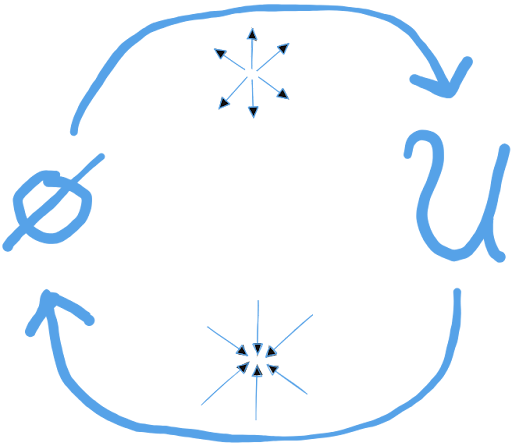
When taken to its logical conclusion it suggests an eternal cycle where the death of one universe marks the beginning of the next, a beautiful and seemingly logical answer. Yet, a familiar feeling of doubt slowly creeps into your mind as you continue to read. But what caused the cycle to start in the first place?
Why “nothing” can’t exist
It seems like we’re getting nowhere. Maybe if we address a specific aspect of the problem we could feel relief. Why could nothing not exist? Well the answer is staring us in the face in its definition: something that does not exist. Either things exist or don’t, there is no middle ground. Since nothing by definition does not exist then something must exist. Hence there was never a point in time when nothing became something because a state of nothingness could never have existed in the first place. Reifying nonexistence into an implicit priori in the fundamental question may have been a mistake. Are we even asking the right question? Perhaps we should clarify with some more meta questions.
Meta questions
Why even ask the fundamental question, does it make sense? Could it be as nonsensical as asking what’s north of the north pole? Perhaps the sense that nonexistence preceded existence comes from the inferred bias we’ve been inflicted with living in a universe bound by cause and effect. We must be open to the possibility that the process that gave rise to existence plays by rules outside the domain of existence. Perhaps the concept of a beginning doesn’t make sense here. Going any further into this line of inquiry may not be productive as it hints at a mode of understanding beyond one which the human mind is capable of realizing.
Now the preceding line of inquiry may have produced in you a conviction that the universe must necessarily exist. However it doesn’t explain why it is designed as perfectly as it appears to us. Well if the universe was imperfect, perhaps a soup of chaotic energy then the conditions required for intelligent life to evolve and ask the fundamental question would not exist. This is the classic anthropic principle which explains away any hint of perfectness as simply a necessary prerequisite for us to exist. Perhaps there are an infinite number of worlds (either parallel or temporally consecutive) and we happened to be one of the universes which were formed with the correct configuration of fundamental constants for intelligent life to eventually form.
Wonder
Every moment feels unreal, surreal, terrifying, and beautiful all at once. Once you actually step outside the metaphysical bubble and look for yourself at the marvel of existence you start to feel as though you are experiencing a tangible paradox. A part of me still thinks that if I think about this long enough I may stumble upon an ineffably indescribable explanation unable to be expressed in human language. I have logically convinced myself that nonexistence shouldn’t be possible yet a part of me still wonders and asks: but why?